
Loading page.
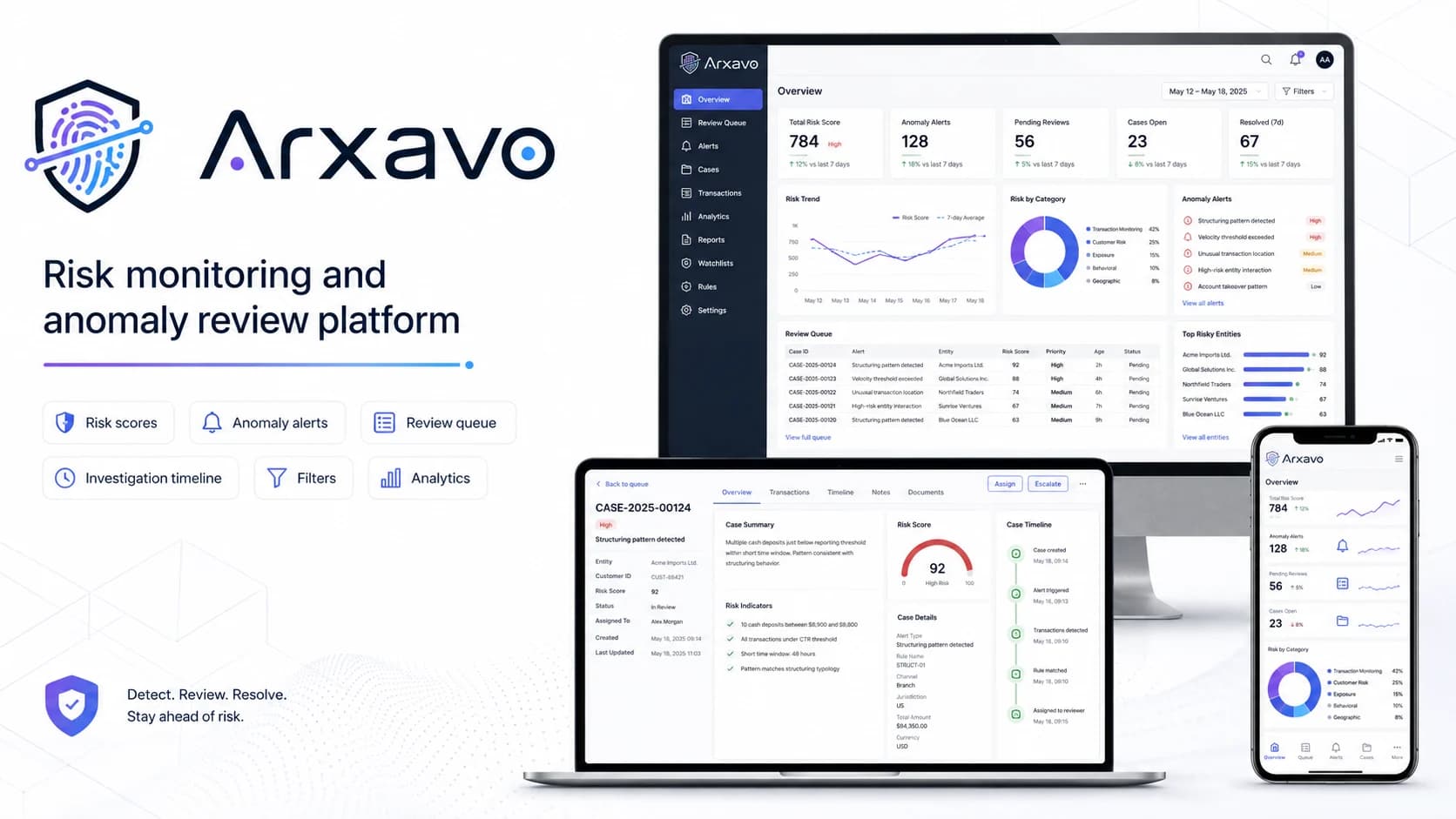
Fraud and anomaly detection dashboard for risk scoring, suspicious activity, and investigation workflows.
Context
Fraud and anomaly review is difficult because suspicious behavior is rarely obvious from one field alone. A transaction amount, login attempt, duplicate pattern, account change, or unusual timing may look acceptable in isolation, but become risky when viewed with surrounding activity.
The intended users for Arxavo are risk analysts, administrators, fraud reviewers, and operations teams responsible for finding abnormal records inside large volumes of activity. These users need prioritization because manually inspecting every record with the same attention is not practical.
Arxavo was built around the idea that fraud tooling should support investigation. The MVP does not claim to be a final fraud authority. It gives reviewers a dashboard where model signals, rule checks, severity levels, filters, and case context can guide where human attention should go first.
Problem
Raw transaction or activity tables can hide risk because the important pattern may be spread across multiple fields. Reviewers may need to inspect amount, frequency, user history, device information, duplicate attempts, location changes, login behavior, or timing before a suspicious record becomes clear.
Without scoring, grouping, or explainable indicators, investigation work becomes slow and inconsistent. Reviewers can spend too much time on low-priority records while missing combinations of signals that should have been escalated sooner.
The product problem was to make suspicious activity easier to prioritize and inspect. Arxavo needed to turn raw records into reviewable cases with risk levels, reasons, and supporting context so the reviewer could understand why something was flagged before deciding what action to take.
Solution
Arxavo processes structured activity records and assigns risk levels using a combination of anomaly scoring and rule-based checks. The system can flag unusual amounts, rapid repeated attempts, duplicate behavior, suspicious login patterns, or records that deviate from expected activity.
The dashboard presents flagged records with severity, risk indicators, filters, and investigation views. Instead of showing a black-box score alone, the interface gives reviewers context that can support triage: what was unusual, which rule or signal contributed, and what related activity should be checked.
The product is framed as decision support for investigation. A reviewer still owns the final decision, but the system reduces the time needed to find suspicious cases, compare signals, and explain why a record deserves attention.
My role
I built Arxavo as a solo full-stack MVP, covering the risk workflow, dashboard structure, scoring approach, data model, backend processing, and review interface. I treated the project as an investigation product rather than a standalone model demo.
The build focused on activity ingestion, anomaly scoring, rule checks, risk levels, suspicious-case filtering, investigation detail views, and report-ready context. The goal was to make machine-learning output useful to a human reviewer, not just produce a numerical score.
The key product decision was to keep model output explainable at the interface level. In risk review, a score is not enough. Reviewers need to know why a case surfaced, what evidence is available, and whether the next action should be monitoring, escalation, or dismissal.
Product workflow
The workflow begins with structured records entering the system. Those records can represent transactions, login events, user activity, or operational events with fields such as amount, timestamp, frequency, account identifier, event type, device, location, and related metadata.
The backend processes those records through anomaly detection and rule checks. Suspicious cases are assigned risk levels and surfaced in a queue where reviewers can filter by severity, signal type, date, user, or case status. That moves investigation away from raw-table scanning and toward prioritized review.
A reviewer can inspect a case, look at contributing signals, compare related records, and decide whether to escalate, monitor, clear, or document the event. The workflow preserves the trail from input record to risk signal to human review outcome.
System architecture
Arxavo is structured around a Next.js and React dashboard, Tailwind CSS interface, FastAPI backend, PostgreSQL records, Python processing, scikit-learn anomaly detection, Isolation Forest concepts, rule-based checks, and investigation views.
The data model includes activity records, entities or users, risk scores, anomaly indicators, rule flags, severity levels, case status, reviewer notes, and investigation outcomes. Keeping these records separate gives the system a clearer path from data processing to reviewer action.
The ML layer is used carefully. Isolation Forest-style anomaly detection can help find unusual patterns, while rule checks cover known suspicious behaviors that are easier to explain directly. Combining both approaches makes the MVP more credible than relying on one opaque output.
A production version would need labeled evaluation data, calibrated thresholds, reviewer feedback loops, audit controls, and stronger governance around false positives and false negatives. The MVP demonstrates the operational shape of a risk dashboard that makes suspicious activity easier to inspect.
Current status
Arxavo is a working MVP focused on anomaly detection and human-readable investigation workflows. It demonstrates how suspicious records can be scored, flagged, filtered, and reviewed through a dashboard built around investigation rather than automatic judgment.
The current version is strongest as a proof of concept for risk-review workflow design. It should not be framed as production-grade fraud detection, but it clearly shows how model signals and rule checks can support reviewer prioritization.
The next step would be adding labeled sample data, calibrating severity thresholds, evaluating false positives, collecting reviewer feedback, and making investigation reports more structured for operational or compliance review.
Outcomes
The main outcome of Arxavo is a risk dashboard that turns raw activity records into prioritized investigation items. Reviewers can see risk levels, contributing indicators, and case context before deciding what action should happen next.
From an engineering perspective, the project strengthened my work with ML-backed dashboards, anomaly detection concepts, rule-based scoring, data modeling for review states, and interfaces where explainability matters as much as prediction.
From a product perspective, Arxavo shows that fraud-related software is strongest when it supports human investigation. The value is not a black-box label; it is helping reviewers find, understand, and document suspicious activity more efficiently.
Reflection
Arxavo taught me that risk tools need humility. A model can surface patterns, but the product still has to account for uncertainty, false positives, domain context, and human review.
The project also made explainability feel practical. Reviewers need signals they can inspect, filters that reduce noise, and case details that help them explain why something was escalated. Those product details are what make a risk dashboard usable.
The broader lesson is that ML becomes more credible when it is connected to a review workflow. Arxavo gave that principle a concrete form through scoring, rule checks, investigation queues, and reviewer-centered case context.