Loading page.
AI meeting assistant that turns recordings or transcripts into summaries, decisions, and tracked tasks.
Context
Most teams do not lose value because they failed to talk about the right things. They lose value after the meeting, when decisions are remembered differently, action items are written inconsistently, and owners or deadlines are left inside scattered notes. The meeting may contain useful direction, but the follow-up process is often too informal.
Cyvello was built for teams, project leads, managers, students, and operations groups that need meetings to become trackable work. The intended user is not only someone who wants a summary. The stronger need is a person responsible for turning conversation into assignments, due dates, and visible progress.
That context shaped Cyvello as a meeting workflow system instead of a plain transcription or summarization tool. The product focuses on what happens after the discussion: what was decided, who owns the next step, when it is due, and how the team can return to the meeting record later without reconstructing everything from memory.
Problem
A transcript can preserve what people said, but it does not automatically make the work clear. A long conversation may contain decisions, blockers, deadlines, unresolved questions, and informal commitments mixed together. If someone has to manually scan the full transcript every time, the meeting record becomes a storage artifact instead of a working tool.
Manual note-taking also introduces gaps. One person may capture the decision but miss the owner. Another may remember the task but not the deadline. In group settings, this creates avoidable confusion because team members leave with different understandings of what should happen next.
The product problem was to extract structure from meeting material and keep that structure actionable. Cyvello needed to separate summary, decisions, action items, owners, deadlines, and task status so the meeting could feed a follow-up workflow instead of ending as a static note.
Solution
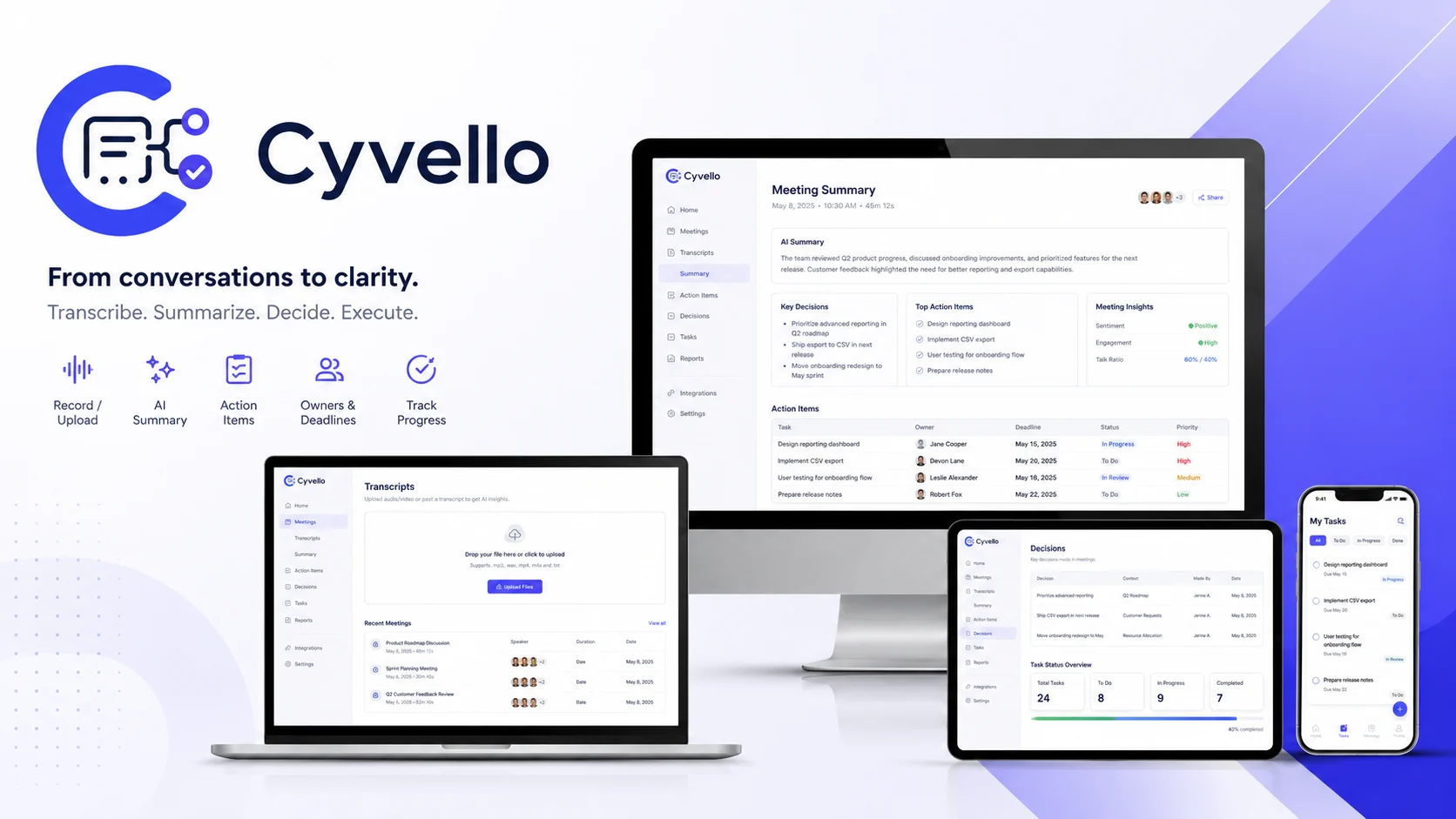
Cyvello accepts meeting recordings, uploaded transcripts, or written notes, then processes the content into organized outputs. The system can produce a concise summary, identify decisions, extract action items, assign owners when mentioned, detect dates or deadlines, and preserve the meeting as a searchable record.
The task layer is the important product step. Extracted action items can move into a status flow such as pending, in progress, completed, or overdue. This keeps the AI output connected to work that someone can review, update, and follow through on after the meeting.
The system is designed to support reminders and future integrations with calendars or task tools. Even without those integrations, the MVP demonstrates the core loop: meeting material enters, structured records are created, action items become trackable, and the team gains a clearer follow-up path.
My role
I built Cyvello as a solo full-stack MVP, owning the product framing, transcript workflow, structured-output design, task model, and interface direction. The main challenge was making generated output useful as product data, not only as a block of AI-written text.
I focused the build around the meeting lifecycle: upload or enter meeting material, process the transcript or notes, extract structured entities, show the summary and decisions, convert action items into task records, and keep meeting history available for later review.
The product judgment was to avoid treating summarization as the finish line. A summary helps users remember, but task records help users act. Cyvello was designed around that difference, so the MVP could show how AI output becomes part of an accountability workflow.
Product workflow
The workflow starts when a user uploads a recording, pastes notes, or provides a transcript. If audio is involved, the system can support a Whisper-style transcription step before analysis. Once the meeting text exists, the system processes it for speakers, topics, key points, decisions, action items, dates, and possible owners.
The output is separated into sections that match how teams review meetings. A user can scan the summary for context, inspect decisions for alignment, and review action items as operational records. Each task can carry a title, owner, source meeting, due date, status, and reminder-ready metadata.
After extraction, the meeting does not disappear. It remains part of a history view where users can return to past discussions, check unresolved tasks, review what was decided, and understand how work moved from conversation into follow-up.
System architecture
Cyvello is structured around a Next.js and React interface, Tailwind CSS styling, a FastAPI backend, PostgreSQL records, OpenAI API usage for structured extraction, Whisper-style transcription for audio input, scheduled reminder logic, and task-tracking data.
The data model separates meetings, transcripts, summaries, decisions, action items, owners, deadlines, task statuses, and reminder metadata. That separation matters because meeting intelligence becomes more useful when each output can be updated, filtered, assigned, or reviewed independently.
The backend coordinates transcription, extraction, validation, and persistence. The frontend focuses on making the result usable: meeting history, extracted sections, task lists, status changes, and review screens that help users inspect what the AI produced before relying on it.
A stronger production version would need calendar integrations, workspace permissions, speaker identification improvements, extraction evaluation, and notification delivery. The MVP proves the central system shape: convert unstructured discussion into records that support accountability.
Current status
Cyvello is a working MVP focused on meeting intelligence and follow-up automation. It demonstrates the key product behavior needed to turn recordings, notes, or transcripts into summaries, decisions, tasks, deadlines, and status-tracked follow-up work.
The current version is strongest as a productized workflow prototype. It shows how meeting content can move into structured records, but it would need deeper testing with varied meeting transcripts before being used as a dependable team operations tool.
The next step would be evaluating extraction accuracy, testing with realistic meetings, improving owner and deadline detection, adding calendar or task integrations, and making reminder behavior configurable for different team habits.
Outcomes
The main outcome of Cyvello is a meeting workflow that turns unstructured conversation into usable follow-up records. Instead of leaving users with only a transcript, the system separates what was discussed from what needs to happen next.
From an engineering perspective, the project strengthened my work with AI structured output, transcription pipelines, task data modeling, reminder-ready records, and interfaces where generated content has to become editable product state.
From a product perspective, Cyvello shows that meeting AI becomes more valuable when it supports accountability. A good summary is useful, but a clear action item with an owner, deadline, and status is what helps teams move work forward.
Reflection
Cyvello reinforced that generated text is only one layer of a productivity product. The stronger value comes when AI output can be reviewed, corrected, assigned, tracked, and connected to the next action.
The project also made me think carefully about ambiguity. Meetings are full of indirect language, unclear ownership, and soft commitments. A useful system should help users clarify those points rather than pretending every conversation has perfectly clean structure.
The broader lesson is that productivity software should reduce the work after the work. Cyvello gave that idea a concrete shape by connecting meeting understanding with task follow-up, reminder readiness, and meeting history.