Loading page.
Low-cost CRM automation system for Philippine MSMEs using Telegram, Google Sheets, and n8n.
Context
LeadSync PH was created for the ISite AI Hackathon, where the challenge was centered on automation. The competition pushed teams to identify a practical problem and solve it by designing an automated workflow, with n8n as one of the core tools for connecting triggers, logic, and external services.
That context shaped how we approached the project. We were not trying to build a large CRM platform from scratch. The better hackathon direction was to solve a focused business workflow using tools that could be connected quickly, demonstrated clearly, and maintained without heavy infrastructure.
Our group chose the sales inquiry problem faced by small businesses. Many Philippine MSMEs already use chat apps and spreadsheets, so the opportunity was to connect familiar tools into a lightweight automation flow: Telegram for input, n8n for processing, Google Sheets for records, and ngrok for exposing webhook-based demo connectivity during development.
Problem
Many small businesses receive customer inquiries through chat apps, social media messages, or informal conversations. Those channels are convenient, but they do not automatically create a structured sales record. A customer can ask about a product, price, availability, or service, but the details may stay buried in the conversation.
When lead information is not captured consistently, business owners have to rely on memory, screenshots, notebooks, or scattered spreadsheets. Customer names, contact details, inquiry type, product interest, lead status, and follow-up notes can be incomplete or missing. That creates delayed replies, repeated questions, and missed opportunities.
The problem is especially important for MSMEs because they often need practical systems without the cost and complexity of a full CRM subscription. LeadSync PH was designed around that reality: give small businesses a simple automation layer that turns inquiries into organized records and follow-up actions.
Solution
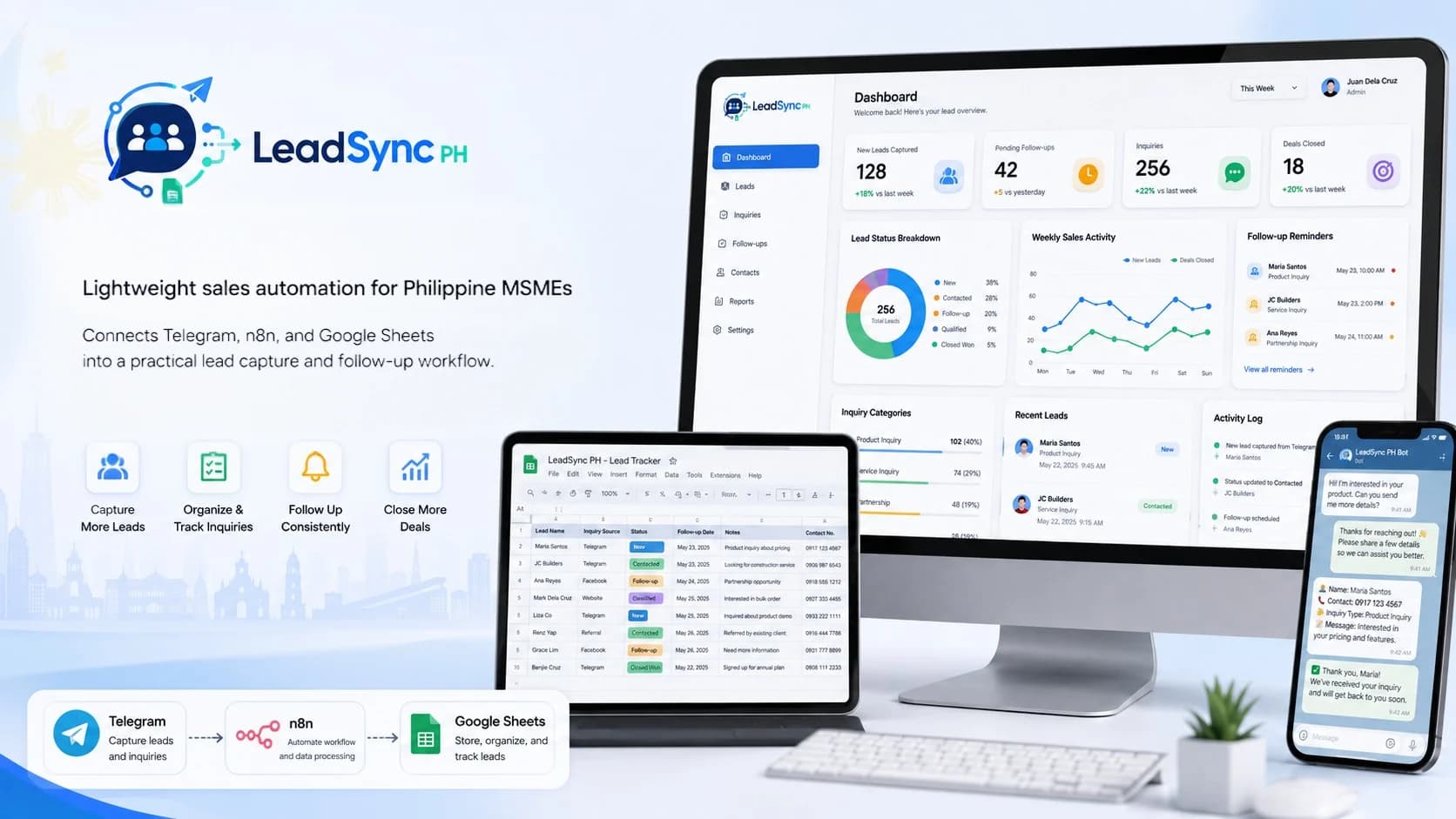
LeadSync PH uses Telegram as the front-facing input channel, n8n as the automation engine, and Google Sheets as the lightweight record system. Instead of asking a small business to adopt a new full CRM platform, the workflow connects tools that are familiar, low-cost, and easy to explain in a hackathon demo.
When an inquiry or lead update is submitted through Telegram, the automation flow can trigger inside n8n, process the message, structure the important information, and write the result into Google Sheets. The row becomes a simple lead record containing the customer details, inquiry category, product or service interest, status, and follow-up notes.
The solution is intentionally lightweight. It gives the business owner a way to capture, organize, and track inquiries without overbuilding. From that base, the workflow can expand into reminders, lead classification, daily summaries, email or SMS notifications, dashboards, or AI-assisted reply drafting.
My role
LeadSync PH was built by a three-member group, and I served as the lead developer. My role was to guide the technical direction of the automation, help shape the workflow logic, and make sure the demo showed a clear problem-solution path instead of only a collection of connected tools.
I worked on the core integration flow: Telegram input, n8n workflow design, webhook handling, Google Sheets record creation, and ngrok-based connectivity for local testing and demonstration. The challenge was to make the automation reliable enough for a hackathon MVP while keeping the setup understandable for judges and users.
As lead developer, I also helped keep the scope focused. With automation tools, it is easy to add many possible branches, notifications, and integrations. We prioritized the core flow first: capture the inquiry, structure the lead, store it in a sheet, and show how follow-up could become easier for MSMEs.
Product workflow
The workflow starts when a customer inquiry or sales update is entered through Telegram. The Telegram bot acts as the simple interface, allowing the business owner or user to submit lead details without opening a separate CRM screen.
The Telegram event triggers the n8n workflow. During development and demonstration, ngrok helps expose the local webhook endpoint so external services can reach the automation flow. n8n then processes the incoming message, applies workflow logic, and prepares the data for storage.
The lead record is written into Google Sheets with structured fields such as customer name, contact details, inquiry type, product or service interest, date received, lead status, and follow-up notes. Once the row exists, the business owner has a lightweight sales tracker instead of a buried chat message.
From there, the same automation can support follow-up reminders, status updates, lead classification, and daily or weekly summaries. The MVP demonstrates the first important step: turning unstructured inquiry activity into a repeatable lead-management workflow.
System architecture
LeadSync PH is centered on n8n. The workflow uses Telegram Bot API events or webhook-style triggers to receive lead information, then passes that data through n8n nodes for processing, routing, filtering, and record creation. This made n8n the main logic layer of the project rather than just a background connector.
Google Sheets functions as the lightweight database. For MSMEs, this is practical because Sheets is familiar, easy to inspect, and does not require a custom admin panel to understand the data. The sheet can store lead rows, statuses, timestamps, notes, and summary-ready information.
ngrok was important during development and demo preparation because it allowed the local automation/webhook setup to be reachable from external services. That made it possible to test and present the Telegram-to-n8n flow in a hackathon environment without needing a full production deployment.
The architecture is intentionally low-cost and modular. Telegram handles input, n8n handles automation logic, Google Sheets stores records, and ngrok supports webhook testing during the MVP stage. Additional nodes can later connect the workflow to email, SMS, dashboards, CRM tools, or AI services for classification and response drafting.
Current status
LeadSync PH is a hackathon MVP built for the ISite AI Hackathon. It is not positioned as a production CRM platform, but it demonstrates a working automation flow for capturing sales inquiries and turning them into structured lead records.
The project is strongest as a practical automation proof of concept. It shows how a small team can use n8n, Telegram, Google Sheets, and ngrok to solve a focused business problem quickly under competition constraints.
The next level of maturity would involve testing the workflow with real inquiry formats, improving message parsing, adding better validation for missing fields, building dashboards, and connecting reminders or notifications to the actual follow-up habits of small business owners.
Outcomes
The main outcome of LeadSync PH is a working automation MVP that connects Telegram, n8n, Google Sheets, and ngrok into a clear sales workflow. It demonstrates how inquiry capture, lead recording, and follow-up support can be handled without building a full custom CRM.
From an engineering perspective, the project strengthened my experience with automation design, webhook-based integrations, n8n workflow logic, API-connected tools, and demo-focused implementation. It also gave me practice in thinking through how small automation decisions affect real business behavior.
From a product perspective, LeadSync PH shows that useful systems do not always need to be large applications. For small businesses, a practical automation that fits existing tools can be more valuable than a complex system that is expensive to adopt and hard to maintain.
Reflection
LeadSync PH taught me that automation is strongest when it respects how people already work. MSME owners may already use chat apps and spreadsheets, so the better solution was not to force a new platform immediately. The better first step was to connect familiar tools into a clearer workflow.
The hackathon setting also made scoping important. We had to choose a problem, build a working flow, and prepare a demo within competition constraints. That pushed me to focus on the core automation path instead of trying to add every possible CRM feature.
As lead developer, I learned how important it is to make integrations explainable. A workflow can technically connect many tools, but the product only becomes convincing when the trigger, processing logic, stored record, and business value are easy to follow. LeadSync PH helped me see automation as product design, not just tool connection.