Loading page.
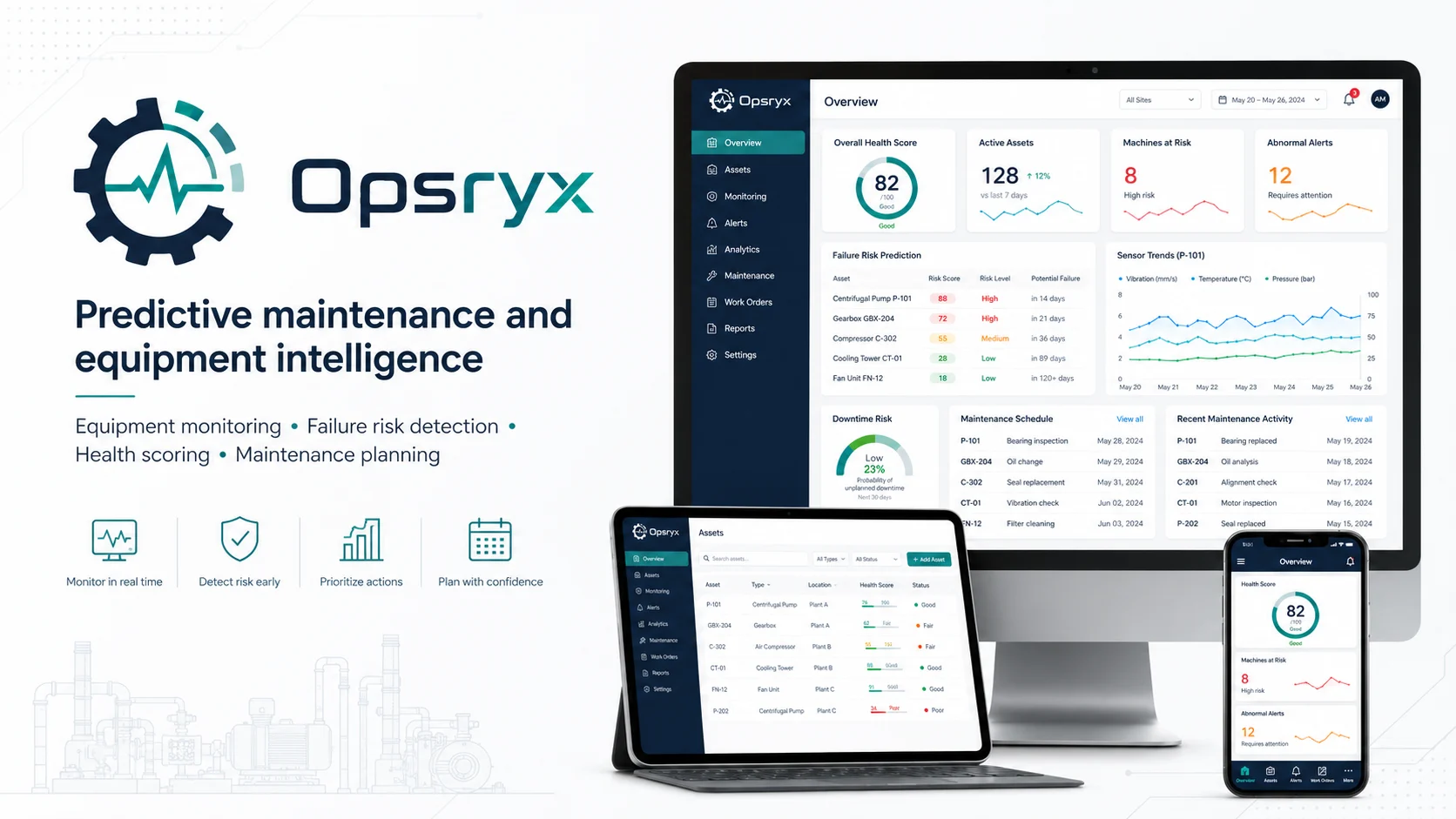
Predictive maintenance dashboard for equipment health, sensor alerts, and failure-risk prediction.
Context
Equipment problems often become expensive because teams respond after the machine has already slowed down, failed, or disrupted operations. In many environments, maintenance planning depends on scheduled checks, technician judgment, error logs, and manual review of sensor readings.
Operations managers, technicians, maintenance planners, and reliability teams need a better way to see when equipment is drifting away from normal behavior. Temperature, vibration, pressure, runtime, energy consumption, and error frequency can all become useful signals when they are tracked over time.
Opsryx was built around that maintenance-planning problem. The product does not claim to prevent every failure. It gives teams a dashboard for equipment health, abnormal readings, failure-risk estimates, and maintenance recommendations so issues can be reviewed before downtime becomes urgent.
Problem
When equipment readings are reviewed manually or only after an incident, early warning signs can be missed. A slight increase in vibration, temperature instability, repeated error codes, or unusual runtime pattern may not look serious until it connects with other signals.
Reactive maintenance also creates planning problems. Repairs become rushed, spare parts may not be ready, technician schedules become harder to manage, and downtime can affect production, service delivery, or operating cost.
The product problem was to organize equipment data into a workflow that supports planning. Opsryx needed to connect sensor readings, maintenance logs, health scores, alerts, and recommended actions so teams could prioritize equipment before failure risk becomes disruptive.
Solution
Opsryx gives each machine or asset an equipment profile with readings, history, health score, abnormal-value alerts, maintenance schedule, and failure-risk estimate. This gives operations teams a single place to review equipment condition instead of jumping between raw logs and manual notes.
The system can process readings such as temperature, vibration, pressure, runtime, energy consumption, and error logs to identify patterns that may deserve attention. Those signals are converted into dashboard states that users can monitor and act on.
The product is framed as maintenance decision support. It helps teams prioritize inspection, plan maintenance timing, and understand equipment trends, while leaving final maintenance decisions to the people who know the environment and machinery.
My role
I built Opsryx as a solo full-stack MVP, covering the maintenance workflow, equipment data model, risk-estimation logic, dashboard interface, alert states, and recommendation flow.
The implementation scope focused on equipment profiles, sensor records, abnormal-reading detection, health-score trends, failure-risk estimates, maintenance schedules, alert queues, and reliability dashboards that help users decide what needs attention.
The key product decision was to connect prediction with planning. A failure-risk number is not useful by itself unless it helps a team decide whether to inspect, schedule maintenance, order parts, or keep monitoring.
Product workflow
The workflow begins with equipment records and machine readings. Each asset can carry metadata, sensor history, operating hours, last maintenance date, error logs, thresholds, and previous maintenance actions.
The system processes incoming or uploaded readings to calculate health signals, detect abnormal values, and estimate failure risk. The dashboard then shows which equipment is stable, which needs monitoring, and which should be prioritized for maintenance review.
Users can inspect trend charts, alert details, health scores, and recommended maintenance timing. That creates a practical loop from machine data to planning action instead of leaving sensor values as raw numbers.
System architecture
Opsryx is structured around a Next.js and React frontend, Tailwind CSS interface, FastAPI backend, PostgreSQL records, Python processing, XGBoost-style modeling concepts, time-series features, alerts, and equipment dashboards.
The data model separates assets, sensor readings, maintenance logs, health scores, risk estimates, alert states, scheduled actions, and recommendation history. This lets the product connect machine behavior with maintenance planning instead of treating predictions as isolated outputs.
The ML layer can use time-series features and maintenance history to estimate risk, while threshold rules can flag abnormal readings directly. Combining predictive and rule-based signals makes the MVP easier to explain and more useful for early review.
A production version would need real sensor histories, domain-specific thresholds, model validation, downtime-cost modeling, technician workflows, and integrations with maintenance management systems. The MVP proves the dashboard shape for monitoring, risk review, and planning.
Current status
Opsryx is a working MVP focused on predictive maintenance and operational decision support. It demonstrates equipment profiles, sensor monitoring, abnormal-reading alerts, health scores, failure-risk estimates, maintenance schedules, and reliability dashboards.
The current version is strongest as a reliability workflow proof of concept. It should be described as failure-risk estimation and maintenance planning support, not as a guaranteed failure-prevention system.
The next step would be testing prediction behavior with realistic sensor histories, calibrating thresholds, adding downtime-cost modeling, and improving how recommendations translate into scheduled maintenance actions.
Outcomes
The main outcome of Opsryx is a dashboard that turns machine readings and maintenance logs into reviewable health signals. Teams can see which assets need attention and why, instead of reacting only after visible failure.
From an engineering perspective, the project strengthened my work with operational dashboards, time-series feature thinking, ML-assisted risk scoring, alert logic, equipment data models, and recommendation interfaces.
From a product perspective, Opsryx shows that predictive maintenance is useful when it becomes schedulable. The product has to help people plan inspections and repairs, not only display a prediction.
Reflection
Opsryx helped me think about ML as part of an operational loop. A model output is only useful when users can understand the signal, compare it with history, and decide what action to take.
The project also showed the importance of explainable planning. Maintenance teams need to know which readings changed, how severe the change is, and whether the recommendation affects scheduling, parts, or technician workload.
The broader lesson is that predictive systems need workflow design. Opsryx gave that idea a reliability-focused shape through asset records, sensor trends, alerts, risk estimates, and maintenance planning.