
Loading page.
Inventory forecasting system for demand prediction, reorder planning, and stockout-risk monitoring.
Context
Small businesses often make inventory decisions with partial information. Owners and staff may know which products feel fast-moving, but they still need clearer visibility into what is actually selling, what is sitting too long, and what could run out soon.
Inventory mistakes create real cost. Overstock ties up cash in products that do not move, while stockouts lose sales and frustrate customers. The challenge is not only predicting demand, but turning that prediction into a practical purchasing decision.
Pryndex was built around that operational problem. The system treats forecasting as a daily workflow for business users who need to understand product movement, stockout risk, reorder timing, and purchasing recommendations without reading a technical forecasting report.
Problem
Inventory decisions are often made from memory, recent sales impressions, or manual stock checks. That makes it easy to miss slow changes in demand, seasonal movement, supplier lead-time pressure, or products that are quietly becoming overstocked.
When the data stays scattered, the business reacts late. Staff may only notice a stockout when a customer tries to buy the product, or only notice overstock after cash has already been locked into slow-moving inventory.
The product problem was to connect product records, sales history, current stock, reorder thresholds, lead time, and safety stock into a dashboard that shows which items need attention before the issue becomes urgent.
Solution
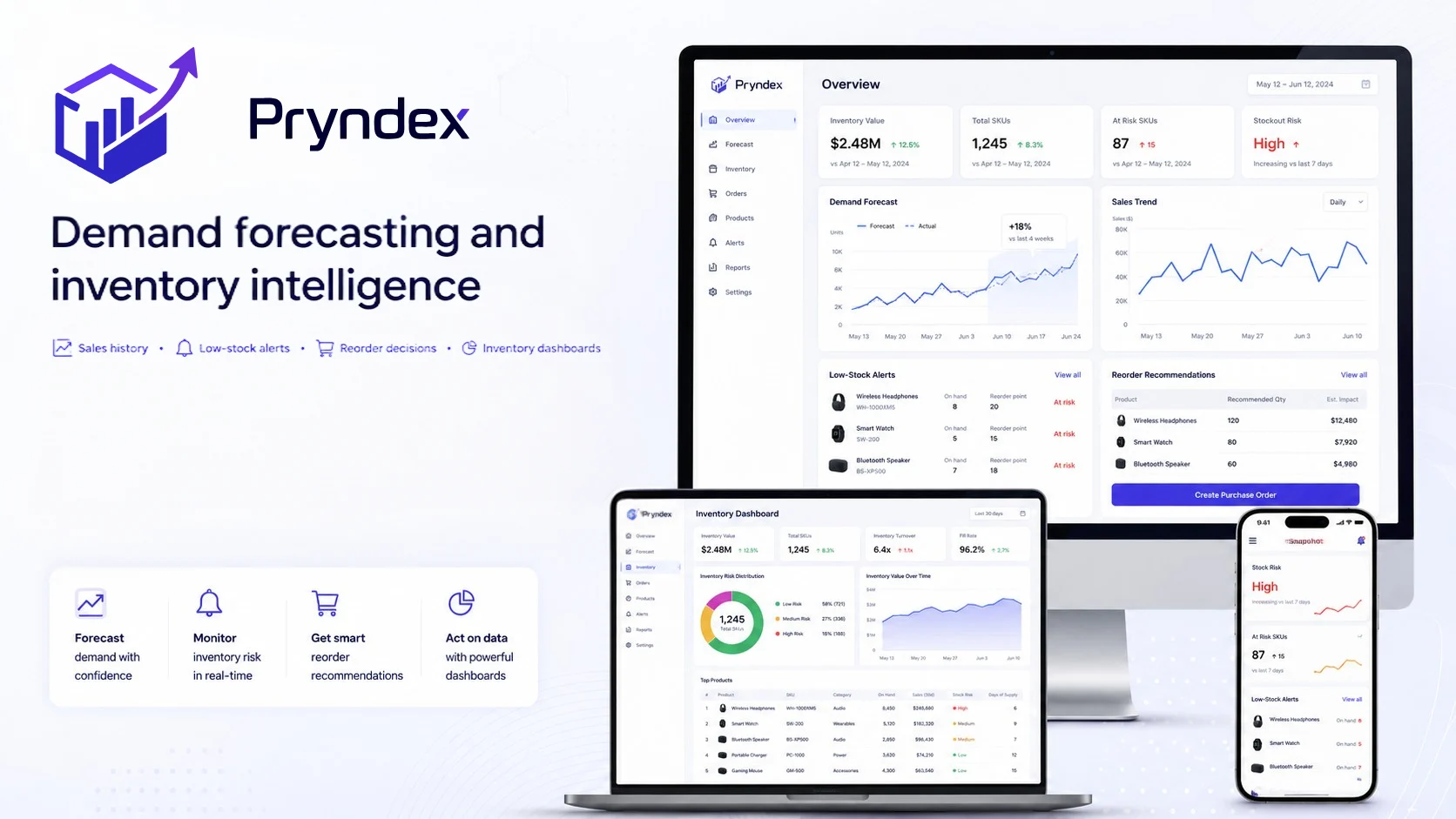
Pryndex combines product records, inventory levels, sales history, and forecasting logic into a dashboard for stock decisions. Users can see demand direction, low-stock alerts, stockout risk, and recommended reorder quantities from one place.
The product value is not only prediction. It is translating product movement into purchasing action. A user should be able to understand which items need attention, why the system is recommending a reorder, and how current stock compares with expected demand.
The MVP is framed as decision support, not a perfect forecasting engine. The system helps users review patterns and assumptions so purchasing can become more structured than memory, manual counts, or last-minute reactions.
My role
I built Pryndex as a solo full-stack MVP, owning the product framing, dashboard flow, inventory data model, forecasting logic, alert states, and recommendation workflow.
The build focused on product records, sales events, stock levels, reorder thresholds, lead-time assumptions, demand forecast outputs, low-stock indicators, reorder recommendations, and dashboard views that make the results easier to act on.
The key product decision was to make forecasting operational. The important question was not only whether the system can produce a number, but whether a non-technical user can understand the recommendation and make a purchasing decision from it.
Product workflow
The workflow starts with product and inventory records: item names, current stock, sales history, reorder thresholds, lead time, and safety stock assumptions. These inputs give the system the context needed to judge whether stock is healthy or at risk.
The system processes movement data and estimates demand direction, stockout risk, and reorder needs. Instead of leaving users with raw tables, Pryndex turns those signals into dashboard alerts, product trends, and recommended actions.
The user reviews products that need attention, compares forecast output with current stock, and decides whether to reorder, monitor, or adjust assumptions. That closes the loop between data analysis and real purchasing behavior.
System architecture
Pryndex is structured around a full-stack web dashboard, backend logic, PostgreSQL-style records, Python-based forecasting concepts, pandas-style data processing, and scikit-learn-style modeling workflows.
The core records include products, sales events, inventory levels, reorder thresholds, lead times, safety stock, forecast outputs, alert states, and recommendation history. These records keep forecasting tied to the stock decisions a user actually needs to make.
The dashboard layer turns the data into operational views: low-stock products, demand trends, stockout risk, overstock signals, reorder suggestions, and product movement summaries. That presentation matters because forecasting only helps if users can understand and act on the output.
A stronger production version would need real sales history, forecast evaluation, seasonality controls, supplier constraints, purchase-order integration, and feedback when recommendations are accepted or ignored. The MVP proves the core stock-planning workflow.
Current status
Pryndex is a working MVP built to demonstrate inventory forecasting and reorder decision support. It shows how product, sales, and stock data can become alerts and recommendations that a business user can review.
The current version is strongest as a forecasting workflow proof of concept. It is not positioned as a validated demand-planning platform, but it has the product structure needed to test forecasting assumptions and purchasing recommendations.
The next step would be testing forecast behavior against sample sales histories, adding scenario controls for lead time and safety stock, and comparing recommendations with realistic inventory decisions.
Outcomes
The main outcome of Pryndex is a stock-planning workflow that turns sales and inventory data into practical purchasing guidance. Users can see which products are moving, what may run out soon, and what should be monitored.
From an engineering perspective, the project strengthened my work with data modeling, dashboard design, forecasting logic, alert states, and backend-supported operational workflows.
From a product perspective, Pryndex shows how predictive features become useful when they connect directly to a decision: what to reorder, when to reorder, and what risk to monitor.
Reflection
Pryndex taught me that forecasting products need to earn trust through clarity. Users need to see the relationship between inputs, assumptions, and recommendations before they rely on the result.
The project also showed that model output is only one part of the system. A useful forecasting MVP needs good records, clear alerts, understandable assumptions, and a workflow that supports repeated decisions.
The broader lesson is that predictive software becomes credible when it is connected to action. Pryndex gave that idea a concrete inventory workflow through product records, demand signals, reorder guidance, and purchasing review.