
Loading page.
Solar proposal intelligence system for cost forecasting, savings projection, and ROI calculation.
Context
Many customers become interested in solar because they want lower electricity bills, but the buying decision quickly becomes difficult. They need to understand how many panels they need, how much the setup will cost, how much of the bill can be offset, whether batteries are worth adding, and how long it will take to recover the investment.
Solar providers face the same problem from the proposal side. A technical recommendation is not enough if the customer cannot understand the savings, assumptions, tradeoffs, and payback timeline. When proposal details are unclear, customers may compare offers only by total price even when system size, battery design, production assumptions, and long-term value differ.
SolarCast PH was built around that decision gap. The project treats solar planning as a forecasting and proposal workflow, not as a basic calculator. The system is designed to turn energy and cost assumptions into projections that homeowners, small businesses, and solar providers can inspect and compare.
Problem
Solar proposals often contain technical details that are meaningful to installers but difficult for customers to evaluate. Panel wattage, inverter capacity, average sun hours, efficiency losses, battery size, installation cost, financing terms, and electricity rate assumptions all affect the financial outcome.
When those assumptions are not visible, the customer may not know why one proposal saves more, why another has a shorter payback period, or whether a battery-backed setup is worth the added cost. That makes the buying decision feel vague even when the numbers are available somewhere in the proposal.
The product problem was to make the calculation path transparent. SolarCast PH needed to show how bill data, system design, and cost assumptions become production estimates, savings projections, payback period, ROI, and long-term cost comparison.
Solution
SolarCast PH lets users enter the key inputs behind a solar proposal: monthly electricity bill, estimated kWh consumption, electricity rate, panel wattage, number of panels, average sun hours, efficiency losses, inverter capacity, battery option, installation cost, and financing or escalation assumptions.
The system converts those inputs into practical outputs such as daily and monthly production, bill offset percentage, monthly savings, annual savings, payback period, ROI, and multi-year electricity cost comparison. The goal is not only to calculate a number, but to explain what assumptions produced it.
The product can support scenario comparison across grid-tie, hybrid, and battery-backed setups. That makes it useful as a proposal support tool because a user can compare options side by side instead of judging a solar investment from one static estimate.
My role
I built SolarCast PH as a solo full-stack MVP, owning the product framing, calculation workflow, input model, output structure, dashboard behavior, and proposal-report direction. The project required connecting software engineering with energy assumptions and financial decision-making.
The implementation scope focused on the pieces that make a solar proposal understandable: bill-to-consumption estimation, system-size inputs, solar production estimates, savings and payback calculations, scenario outputs, charts, and report-ready summaries.
The key product decision was to prioritize explainable calculations over a black-box recommendation. Users should be able to see the assumptions, adjust inputs, compare scenarios, and understand why the system produced a specific savings or payback estimate.
Product workflow
The workflow starts with the user's electric bill and electricity rate. From there, the system can estimate monthly kWh consumption and use that demand as the baseline for sizing and savings calculations. This makes the first step understandable because most customers know their bill even if they do not know their energy usage.
Next, the user enters system assumptions such as panel wattage, panel quantity, sun hours, losses, inverter size, battery option, and installation cost. The system estimates production and compares it with the user's demand to calculate bill offset, savings, ROI, and payback.
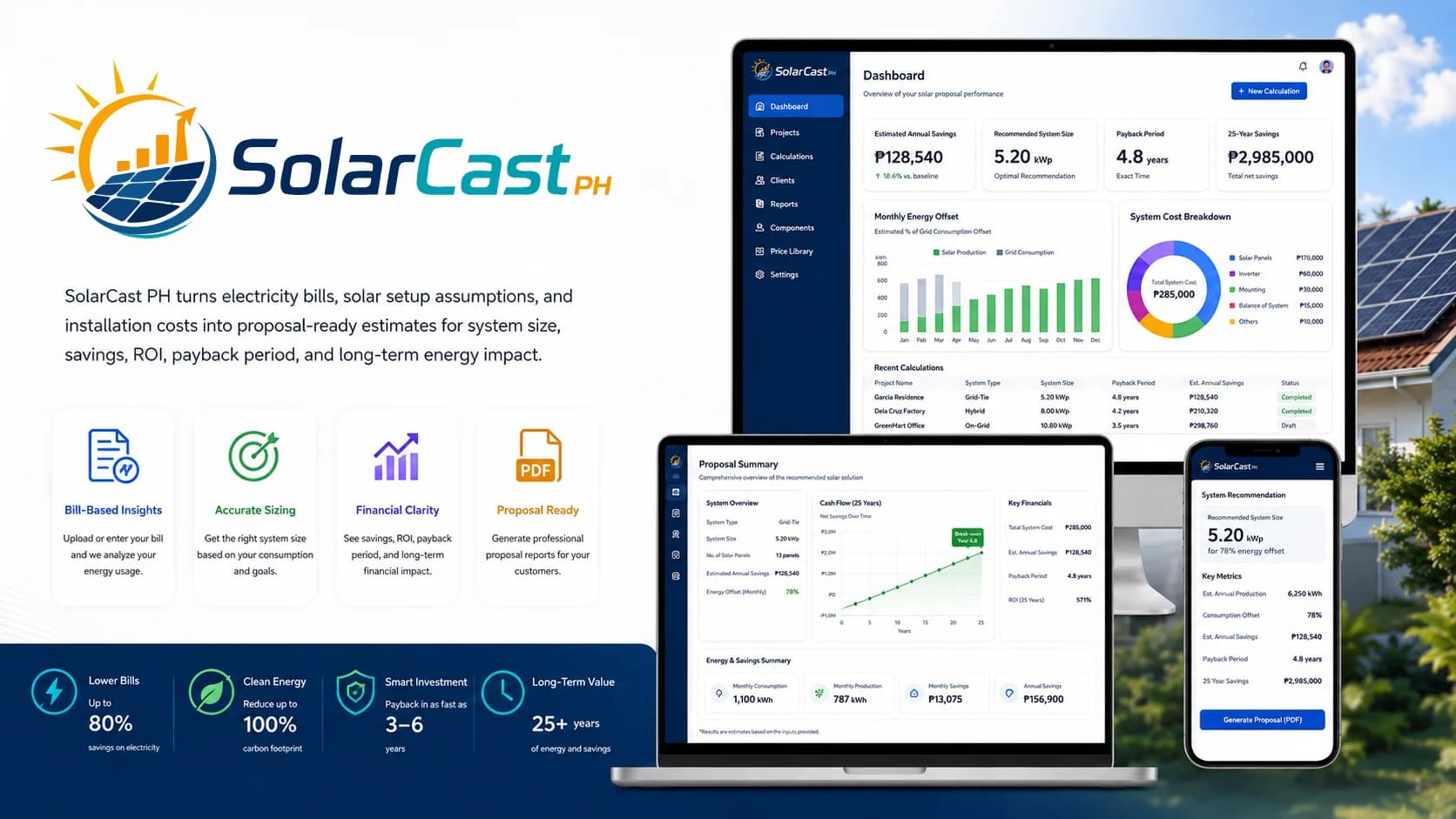
The output is presented as a proposal-style dashboard with projections, charts, and scenario summaries. A stronger version can export a PDF report that explains assumptions, shows cost comparisons, and gives the customer a clearer way to evaluate solar options.
System architecture
SolarCast PH is structured around a Next.js and TypeScript frontend, FastAPI backend, PostgreSQL records, Recharts-style visualizations, a calculation engine, and PDF generation for proposal reports. The frontend handles input forms, scenario views, and visual summaries, while the backend can preserve assumptions and generated proposal records.
The calculation model separates consumption estimates, solar production assumptions, cost assumptions, battery assumptions, savings outputs, payback calculations, and multi-year projections. Keeping those concepts separate makes the system easier to validate and extend.
The visual layer matters because solar decisions are easier to trust when users can see the relationship between inputs and outputs. Charts can show monthly savings, cumulative savings, payback timeline, bill offset, and long-term grid-cost comparison.
A production version would need localized electricity-rate data, stronger formula validation, seasonal generation modeling, financing options, customer profiles, proposal templates, and real installer feedback. The MVP proves the core product loop: assumptions enter, calculations run, scenarios compare, and proposal outputs become easier to understand.
Current status
SolarCast PH is a working MVP built around calculation logic and proposal automation. It demonstrates how solar setup assumptions can become understandable outputs for system size, projected savings, ROI, payback period, and long-term energy cost impact.
The project is strongest as a proposal-intelligence proof of concept. It shows the calculation workflow and business communication layer, while leaving room for deeper formula validation, local solar assumptions, and installer-specific proposal rules.
The next step would be validating formulas against realistic solar examples, improving scenario comparison, adding seasonal assumptions, refining battery feasibility logic, and generating polished client-ready PDF reports.
Outcomes
The main outcome of SolarCast PH is a product flow that turns solar investment assumptions into financial projections customers can understand. Instead of presenting a vague estimate, the system shows the path from bill data to production, savings, ROI, and payback.
From an engineering perspective, the project strengthened my work with calculation engines, data visualization, structured input models, financial projection logic, backend-supported reports, and proposal-style product flows.
From a product perspective, SolarCast PH shows how software can improve a complex buying decision by making assumptions visible. The value is not only in doing math; it is in making the math inspectable enough for customers to trust.
Reflection
SolarCast PH taught me that calculation products need clarity as much as accuracy. A correct number is weak if the user cannot understand the assumptions behind it or compare it with another scenario.
The project also made the connection between engineering and sales communication clearer. Solar providers do not only need calculations; they need a way to explain recommendations in a format customers can review, question, and trust.
The broader lesson is that technical outputs become more valuable when they are translated into decisions. SolarCast PH gave that principle a concrete form through bill inputs, production estimates, financial projections, charts, and proposal-ready reports.