Loading page.
AI resume and job matching platform for match scores, skill gaps, and resume improvement suggestions.
Context
Many applicants submit resumes without knowing how closely their experience matches a specific role. A resume may be generally good but still miss the keywords, tools, responsibilities, or evidence that a target job description expects. This is especially difficult for students, career switchers, and applicants who are applying across different roles.
Generic AI resume advice can make the problem worse if it encourages users to sound impressive without grounding suggestions in real experience. Career tools need to be careful because a resume is not just marketing copy; it is a representation of a person's actual background.
Taloryn was built around that boundary. The product focuses on evidence-based resume improvement: compare the user's resume with a target job, identify where the alignment is strong or weak, and suggest improvements that stay connected to the user's real experience.
Problem
Applicants often do not know which parts of a job description matter most. Required skills, preferred tools, years of experience, certifications, education, responsibilities, soft skills, and domain keywords may all appear in the posting, but not all of them carry equal weight for the user's current resume.
Without a structured comparison, users may submit the same resume repeatedly, overlook relevant experience they already have, or add vague AI-generated language that does not reflect what they actually did. That hurts credibility and makes the application less targeted.
The product problem was to turn resume improvement into a matching workflow. Taloryn needed to parse both documents, extract comparable signals, show the match clearly, and guide the user toward honest improvements rather than fabricated qualifications.
Solution
Taloryn lets users upload or enter a resume and a target job description. The system extracts structured signals from both sides, including skills, tools, experience themes, education, certifications, responsibilities, keywords, and role-specific requirements.
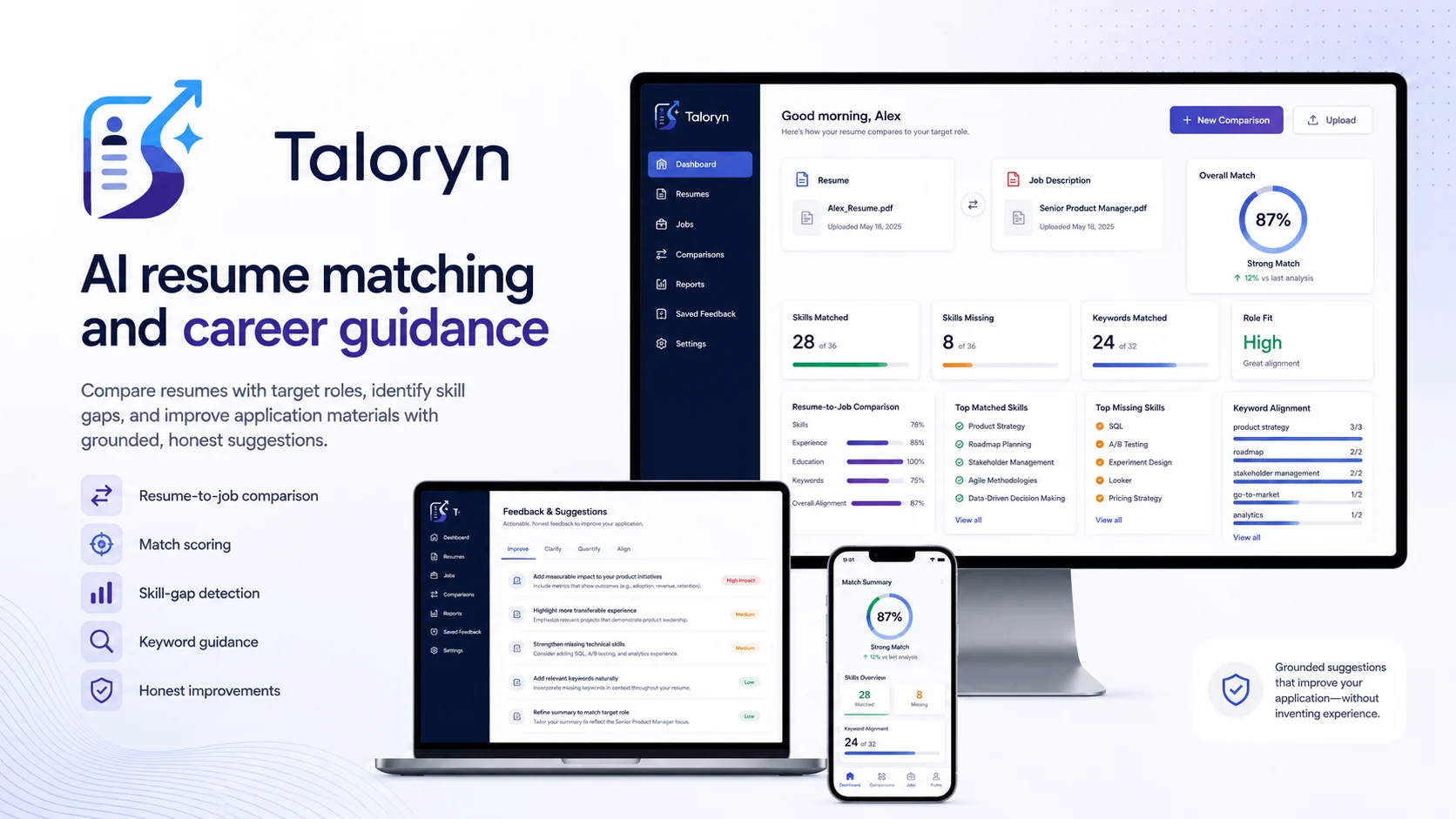
The system compares those signals through semantic similarity, keyword overlap, weighted scoring, and skill-gap analysis. It can return a match score, matched strengths, missing requirements, recommended keywords, weak resume bullets, and suggestions for how the user can better present relevant experience.
The feedback is constrained by the user's existing background. Instead of inventing experience, Taloryn can suggest rewriting weak bullets, surfacing overlooked evidence, reordering emphasis, or recommending learning paths for gaps that the resume does not currently support.
My role
I built Taloryn as a solo full-stack MVP, owning the product framing, resume parsing workflow, job-description analysis, scoring model, AI feedback rules, and dashboard interface. The main challenge was balancing useful AI guidance with credibility and honesty.
The implementation scope covered document input, PDF parsing, structured extraction, resume and job signal comparison, match scoring, skill-gap detection, keyword recommendations, and improvement feedback that users can review before applying.
The key product decision was to make the system an assistant, not an exaggeration engine. The application should help users understand fit, communicate stronger evidence, and prepare better materials without crossing into dishonest resume generation.
Product workflow
The workflow begins when a user provides a resume and a target job description. The system extracts resume content into structured categories such as skills, roles, projects, education, certifications, achievements, tools, and experience themes.
The job description is analyzed separately for required skills, preferred qualifications, responsibilities, keywords, and signals that indicate what the employer values. The system then compares both sides to produce match scoring, missing-skill insights, and evidence-backed recommendations.
The final output is designed for action. A user can see which parts of the resume already support the job, where the resume is weak, which keywords may be missing, and which bullets could be rewritten to better show relevant experience.
System architecture
Taloryn is structured around a Next.js and React frontend, Tailwind CSS interface, FastAPI backend, PostgreSQL records, OpenAI API usage, embeddings, PDF parsing, semantic similarity, keyword overlap, and resume parsing logic.
The data model separates resumes, job descriptions, extracted signals, match scores, gap findings, keyword suggestions, feedback items, and report outputs. This keeps the workflow explainable because each recommendation can be tied back to either the resume, the job description, or a comparison between the two.
The AI layer is used for structured extraction and feedback, while scoring combines semantic and keyword-based signals. That hybrid approach makes the result easier to reason about than a single generated paragraph that simply says whether a candidate is a good fit.
A stronger production version would need better parsing across resume formats, calibration across job families, user profile history, exportable feedback reports, and testing against sample roles. The MVP proves the central career-support loop: compare, score, explain, and guide improvement responsibly.
Current status
Taloryn is a working MVP focused on resume analysis and job matching. It demonstrates how resumes and job descriptions can be parsed, compared, scored, and converted into feedback that helps users prepare more targeted applications.
The current version is strongest as a career-support proof of concept. It should not be positioned as a hiring predictor or application guarantee; its value is in helping users understand alignment and improve how they present real experience.
The next step would be testing scoring quality against sample job descriptions, improving feedback specificity, adding exportable reports, and giving users clearer controls for accepting or rejecting suggested resume changes.
Outcomes
The main outcome of Taloryn is a workflow that turns a broad job posting into specific resume feedback. Users can see what matches, what is missing, and how to improve application materials without relying on generic advice.
From an engineering perspective, the project strengthened my work with document parsing, semantic comparison, structured extraction, scoring logic, AI-generated feedback, and product safeguards around sensitive user-facing recommendations.
From a product perspective, Taloryn shows that AI career tools should be evidence-aware. The strongest version of the product helps users present themselves clearly, not pretend to have experience they do not have.
Reflection
Taloryn made me think carefully about the boundary between assistance and overstatement. Resume tools can create real consequences, so the system has to respect what the user has actually done.
The project also showed that scoring is only useful when users can understand it. A match percentage without explanation feels arbitrary, but a score paired with matched skills, missing requirements, and source evidence becomes more actionable.
The broader lesson is that AI products need domain-specific constraints. In Taloryn, that means grounding feedback in resume evidence and job requirements so the product improves clarity without damaging trust.