Loading page.
Research assistant with source-grounded summaries, citation mapping, and claim checking.
Context
Students, researchers, analysts, and knowledge workers often need to synthesize information across PDFs, reports, notes, articles, and links. The hard part is not only producing a summary; it is keeping track of which source supports which claim.
AI research answers can sound confident even when the user cannot see the evidence behind them. That creates a trust problem. If citations, source passages, contradictions, and claim relationships are hidden, users may accept unsupported statements or spend extra time tracing generated text back to the original material.
Varqon was built around that trust gap. The product is a research workspace that prioritizes source grounding over freeform generation. Its purpose is to help users ask questions, inspect retrieved evidence, compare claims, and build notes without losing the connection to source material.
Problem
A normal AI answer may be readable, but it can be difficult to verify. When the system does not show the relevant passages, users cannot easily tell whether the answer is supported, partially supported, contradicted, or missing important context.
Research work also involves comparison. Two documents may define a term differently, report different numbers, or disagree on a conclusion. If the tool only summarizes one answer, it may hide those tensions instead of helping the user reason through them.
The product problem was to make source material visible inside the AI workflow. Varqon needed to parse documents, retrieve passages, cite answers, expose claims, and support comparison so users can inspect the evidence instead of trusting generated text blindly.
Solution
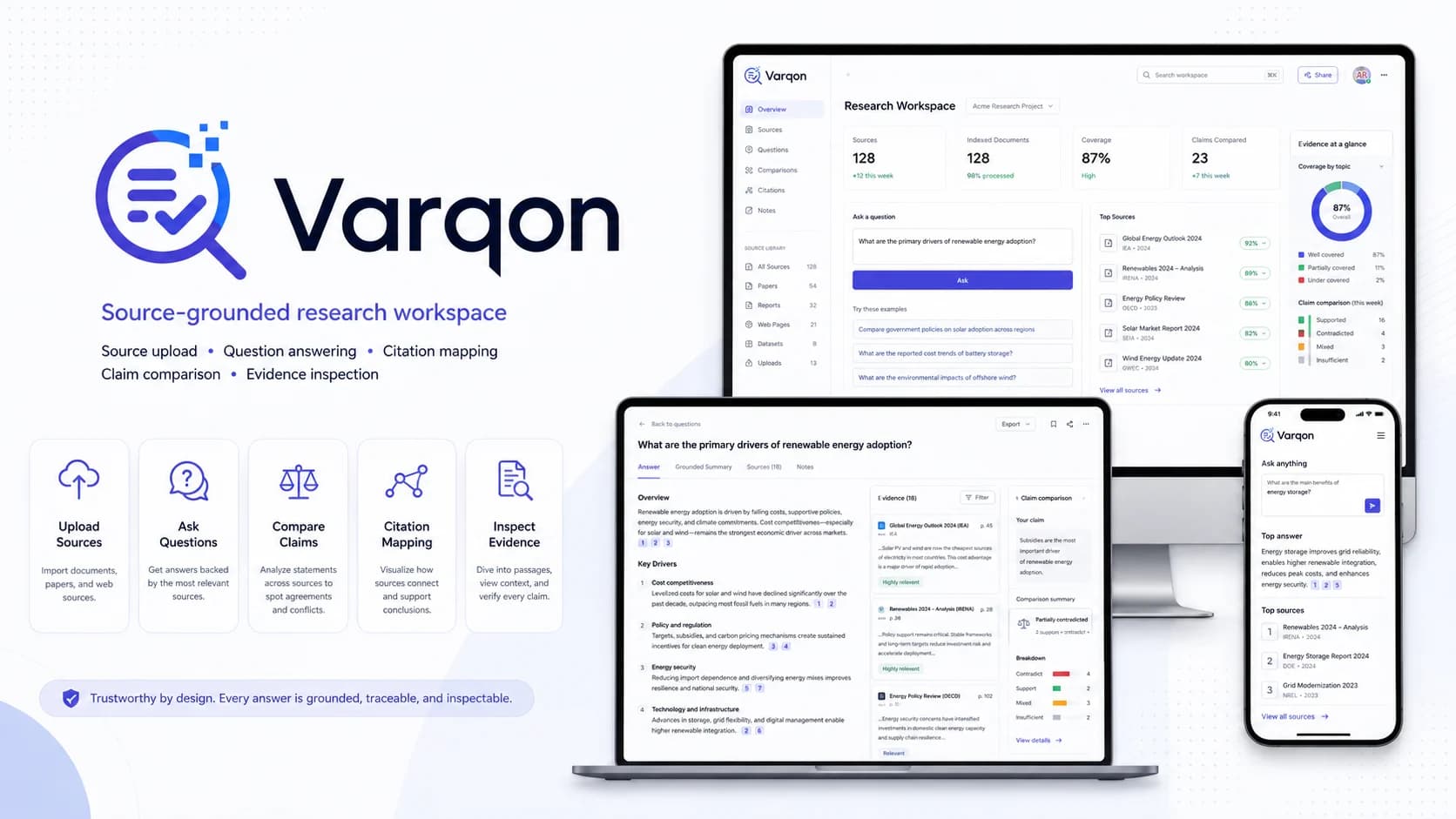
Varqon lets users add documents or links, then indexes the material for retrieval. When a user asks a question, the system retrieves relevant passages, generates an answer from that context, and links the response back to source evidence.
The workspace can organize citations, source previews, extracted claims, research notes, and comparisons between documents. Instead of only giving a final answer, Varqon helps users see where the answer came from and whether the underlying evidence is strong.
The product is designed for research review. Users can inspect citations, compare source passages, identify contradictions, and decide whether an answer is useful enough to keep in their notes or needs further checking.
My role
I built Varqon as a solo full-stack MVP, covering the product framing, document ingestion flow, RAG architecture, citation mapping, claim comparison, research workspace structure, and interface direction.
The implementation scope focused on document upload, PDF parsing, chunking, embeddings, vector retrieval, source-grounded answering, citation display, source comparison, claim extraction, and note generation.
The key product decision was to make the evidence visible. In a research assistant, a fluent answer is not enough. The user needs to inspect source passages and understand the relationship between generated output and original material.
Product workflow
The workflow begins when a user adds source material such as PDFs, notes, reports, or links. The system parses the content, breaks it into chunks, generates embeddings, and stores those chunks for semantic retrieval.
When the user asks a question, the retrieval layer finds relevant passages and passes them into the answer-generation step. The response is then shown with citations or source references so the user can inspect the supporting material.
The workspace can also support claim review. Important statements can be extracted, compared across sources, and marked as supported, contradicted, or needing further review. This turns the product into a research workflow rather than a simple chat box.
System architecture
Varqon is structured around a Next.js and React frontend, Tailwind CSS interface, FastAPI backend, PostgreSQL with pgvector, OpenAI API usage, PDF parsing, embeddings, retrieval-augmented generation, citation mapping, and research-note records.
The data model separates sources, documents, chunks, embeddings, questions, retrieved passages, answers, citations, extracted claims, notes, and comparison results. That structure keeps the answer connected to the evidence that produced it.
Citation mapping is a core product concern. The interface needs to show not only that an answer has sources, but which passage supports which part of the answer. That helps users evaluate the output and catch unsupported claims.
A production version would need stronger citation previews, source permission controls, link ingestion robustness, retrieval evaluation, contradiction detection, and workspace collaboration. The MVP proves the central loop: index sources, retrieve evidence, answer with citations, and support research review.
Current status
Varqon is a working MVP focused on source-grounded research assistance. It demonstrates document indexing, semantic retrieval, source-based summarization, citation organization, claim checking, and research note generation.
The current version is strongest as a RAG workflow proof of concept. It should be framed around evidence visibility and research support, not as a replacement for careful reading or expert review.
The next step would be adding stronger citation previews, improving source comparison views, evaluating retrieval quality against known questions, and making claim review more explicit for contradictions or unsupported statements.
Outcomes
The main outcome of Varqon is a research workflow where answers remain connected to sources. Users can retrieve relevant passages, inspect citations, compare claims, and keep notes without losing the evidence trail.
From an engineering perspective, the project strengthened my work with RAG architecture, document chunking, vector search, source-grounded generation, citation mapping, and research workspace data models.
From a product perspective, Varqon shows that trustworthy AI interfaces need evidence visibility. The strongest value is not the summary alone, but the user's ability to inspect and challenge the source behind it.
Reflection
Varqon reinforced that research AI should make verification easier, not harder. Users need to see the source material, compare claims, and decide how much confidence to place in an answer.
The project also showed that RAG is a product design problem as much as a technical pattern. Retrieval quality, citation display, source previews, and claim mapping all affect whether the user can trust the system.
The broader lesson is that AI becomes more useful when it exposes its evidence. Varqon gave that idea a practical research-workspace shape through document indexing, source-grounded answers, and citation-first review.