
Loading page.
AI-assisted fraud-risk layer for suspicious identity submissions in e-KYC and account recovery workflows.
Context
Digital financial services increasingly depend on remote identity decisions. Banks, e-wallets, lending platforms, and fintech products often ask users to submit identity documents, selfies, facial scans, or short verification videos before they can open accounts, recover access, or continue using sensitive financial services.
That convenience also creates risk. Identity evidence can be forged, reused, spoofed, manipulated, or submitted in ways that make a simple pass-or-fail verification result difficult to trust. Account recovery is especially sensitive because an attacker who successfully passes recovery can regain access to an existing account, not just create a new one.
VeriGuard AI was built from that high-trust context. For our Entrepreneurial Mind course, our seven-member group treated the project as a startup-style fintech MVP: a product that explores how fraud, risk, and compliance teams could review suspicious identity submissions with better risk context, clearer escalation, and stronger auditability.
Problem
The problem is not only whether an e-KYC check passes or fails. Many identity cases sit in a gray area where the evidence looks suspicious but still needs human judgment. A document may appear valid while the selfie looks inconsistent. A recovery request may match some information but still carry behavioral or contextual risk. These cases need structured review, not only an automatic decision.
Without a dedicated review workflow, fraud teams may have to inspect evidence across disconnected tools, rely on inconsistent notes, or escalate cases without a clear record of why a decision was made. That becomes risky in financial services because identity decisions affect access, money movement, customer trust, and institutional accountability.
The project needed to solve a workflow problem around uncertainty. When the system is not fully confident, analysts need a queue, evidence summaries, risk indicators, notes, escalation options, and decision history. The goal is not to let AI replace fraud teams, but to help reviewers make better-documented decisions when identity evidence becomes questionable.
Solution
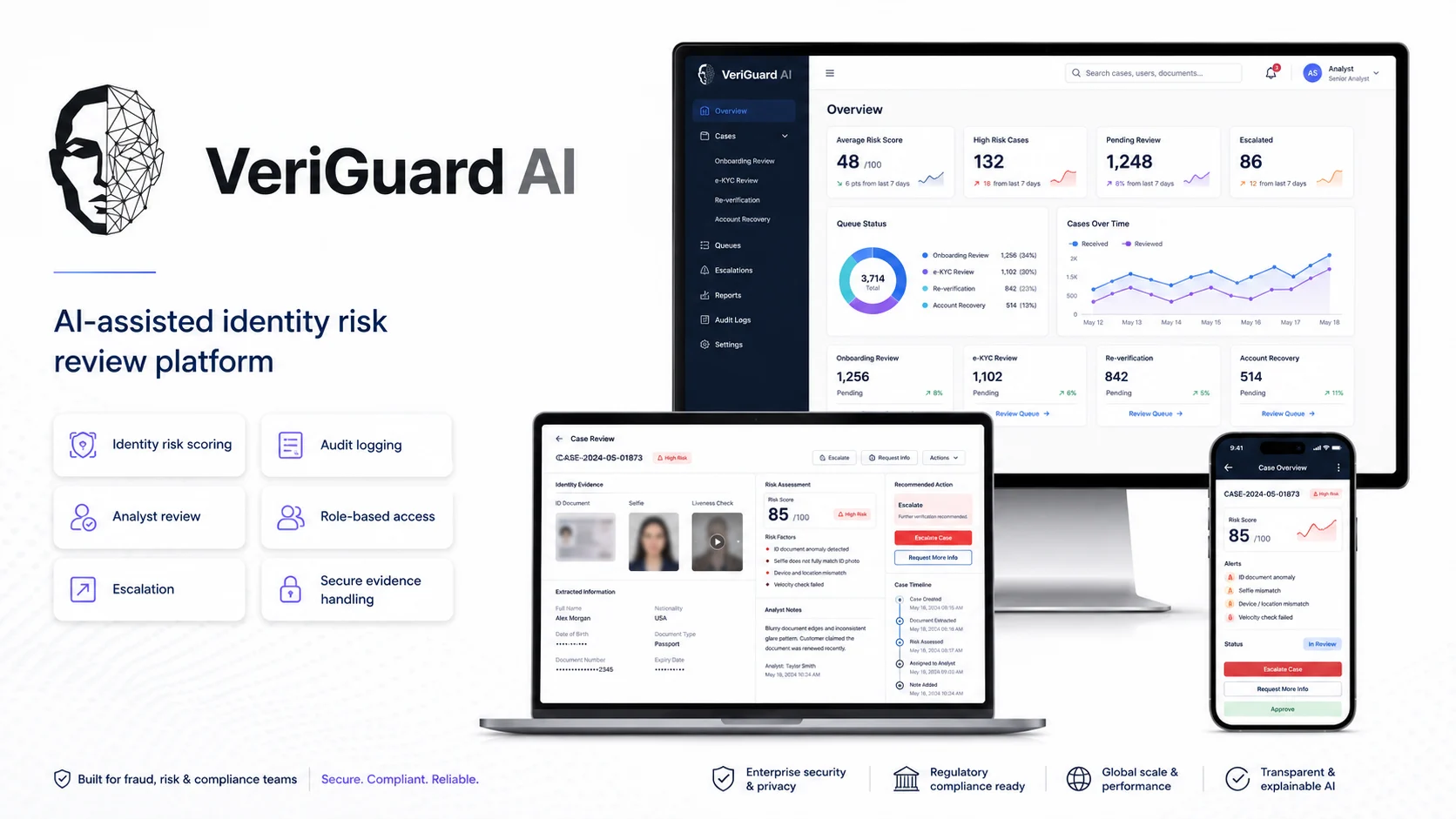
VeriGuard AI gives suspicious identity submissions a structured fraud-review workflow. A case can enter the system with applicant details, submitted evidence, risk indicators, and review status. The MVP demonstrates how an analyst could inspect the case, understand why it was flagged, and decide whether to approve, reject, escalate, or require step-up verification.
The product is built around AI-assisted risk support rather than automatic enforcement. The risk layer can summarize suspicious signals, assign a risk level, and help prioritize cases, but the final workflow remains human-in-the-loop. That distinction is important because identity fraud decisions are sensitive and need accountability, especially in financial contexts.
The MVP also includes the idea of audit-ready decision records. Notes, status changes, analyst actions, and case outcomes should not disappear after a decision is made. They become part of the record that helps a fraud team explain what happened, review repeated patterns, and improve future detection or escalation rules.
My role
VeriGuard AI was a seven-member startup project for our Entrepreneurial Mind course, and I served as both the team leader and lead developer. My role was to keep the business idea, product workflow, and technical implementation aligned so the project could be presented as more than a pitch deck.
As team leader, I helped shape the startup direction: target users, product modules, fraud-review positioning, MVP scope, business model, and the story of how the product could fit into fintech operations. The challenge was making the idea credible without overstating production readiness or claiming institutional validation we did not have.
As lead developer, I guided and implemented the core MVP workflow. I focused on turning the startup concept into a working product demonstration: suspicious identity cases, risk review, analyst decision states, evidence-oriented screens, and a system structure that could explain how AI support, human review, and audit trails would work together.
Product workflow
The workflow begins when a suspicious identity case enters the system. In a real fintech environment, that case could come from onboarding, e-KYC verification, re-verification, or account recovery. In the MVP, the case represents the evidence and context an analyst would need to review before trusting or rejecting the identity attempt.
Once the case is available, the system presents the identity details, submitted evidence, risk level, and suspicious indicators. The analyst can inspect the case instead of only seeing a generic pass-or-fail result. This makes the workflow more useful for borderline cases where a reviewer needs to understand what specifically caused the concern.
After review, the analyst can move the case toward an outcome such as approve, reject, escalate, or request additional verification. The decision can be stored with notes and status history so the result is not just an isolated action. It becomes part of an audit trail that supports follow-up, internal review, and future fraud-pattern analysis.
System architecture
The MVP was structured around a fraud-operations dashboard rather than a consumer-facing identity app. The important product surface is the analyst workflow: case queue, evidence review, risk scoring, decision states, notes, and audit history. That makes the system closer to a decision-support tool than a simple AI detector.
At the application level, the system needs a frontend for reviewers, a backend or logic layer for case handling, and a database structure for identity cases, risk signals, analyst notes, status changes, and decisions. The AI layer supports risk scoring and signal explanation, while the product layer makes those outputs reviewable by a human.
The architecture is intentionally careful about trust boundaries. Identity evidence is sensitive, so a real production version would need secure storage, strict access control, privacy-aware retention rules, and integration with existing e-KYC or account recovery systems. For the course MVP, the goal was to demonstrate the workflow and product logic without claiming production-grade financial deployment.
This architecture follows the actual decision process. AI helps summarize risk, analysts inspect the evidence, the system captures actions, and the record remains available for audit. That structure is what makes VeriGuard AI stronger than a generic fraud-detection demo: it treats fraud review as an operational workflow with people, evidence, and accountability.
Startup model
Because VeriGuard AI was built for an Entrepreneurial Mind course, the project had to work as both a product and a startup concept. We positioned it for B2B fintech use cases where the buyer is not the end user submitting an ID, but the institution responsible for fraud prevention, onboarding quality, account recovery safety, and compliance documentation.
The startup positioning focused on financial institutions, e-wallets, online lending platforms, and digital identity teams that already have verification tools but still need better support for suspicious or escalated cases. That made the product direction more believable than trying to replace existing e-KYC systems entirely.
The business model was shaped around paid pilots, subscription access, enterprise integration, and implementation support. Those ideas were not treated as decoration; they influenced the MVP framing. If a fraud team is the customer, the product has to show analyst workflow, review traceability, and operational fit, not only an AI score.
Current status
VeriGuard AI is a working MVP from a seven-member course startup project. It is not a production-deployed fraud platform inside a financial institution, and it should not be described as compliance-approved or enterprise-validated. Its current strength is that it turns the startup idea into a demonstrable product workflow.
At this stage, the MVP is best understood as entrepreneurial validation: it shows how suspicious identity review could be structured, how AI-assisted risk output could support analysts, and how decision records could be preserved for review. That is a meaningful step beyond a written business proposal because the product logic can be seen and tested as a workflow.
The next level of maturity would involve synthetic fraud-case datasets, clearer scoring explanations, stricter role-based access, secure evidence handling, and feedback from people familiar with fraud operations, compliance, or digital onboarding. Those steps would move the MVP from course validation toward stronger domain validation.
Outcomes
The main outcome of VeriGuard AI is a working startup MVP that connects fintech product strategy with a fraud-review workflow. The project includes the product direction, target users, startup positioning, risk-review concept, analyst workflow, and MVP implementation needed to explain how the system could operate.
From a leadership perspective, the project gave me experience guiding a seven-member team through both business and technical work. I had to keep the startup narrative, product scope, and MVP build aligned so the final output did not feel like separate research, pitch, and software pieces.
From a technical and product perspective, VeriGuard AI shows how high-stakes AI products should be framed carefully. The value is not simply detecting fraud; it is giving reviewers better evidence, clearer risk context, documented decisions, and a workflow that respects uncertainty.
Reflection
VeriGuard AI taught me that high-trust products need careful language and careful design. It would be easy to describe an AI fraud tool as if it can automatically solve identity risk, but that would be irresponsible. In sensitive domains like finance, AI should support judgment, not hide uncertainty behind a confident interface.
The project also made auditability feel central to product quality. A fraud decision is not complete when a button is clicked. The team needs to know what evidence was reviewed, what risk indicators mattered, who made the decision, and why the case moved forward or stopped. That record is part of the product.
As both leader and lead developer, I learned how different a startup MVP feels from a normal school system. The work had to answer business questions and technical questions at the same time: who would buy it, why they would trust it, what workflow it improves, what the MVP proves, and what still needs validation before it could become a real fintech product.